
Coffee Example
Context
Stackable Jacks Method can extract a surprising amount of analytical value from a single stakeholder statement.
For this use case, we take an everyday statement and process it through the full SJM lifecycle: RAISE, SCRUTINISE, TRACE, PRIORITISE, EXPRESS, COMPOSE, and PERCEIVE.
The stakeholder statement is:
“I want a cup of coffee in the morning on my desk.”
Initial observations
The statement is:
- concise;
- straightforward;
- easy to understand.
However, it also:
- proposes a solution;
- contains subjective language;
- limits further exploration.
Let’s apply Stackable Jacks Method.
Jack Semantics – RAISE
Input
Stakeholder statement:
“I want a cup of coffee in the morning on my desk.”
Action
RAISE each semantic element to the appropriate analytical level:
- I → a single person
- Want → shall have
- Cup → portioned
- Coffee → refreshment
- In the morning → before major activities start
- On my desk → readily available
Output
“A single person shall have a portioned refreshment readily available before major activities start.”
The transformed statement is:
- concise;
- understandable;
- solution-agnostic;
- less subjective.
Sidenotes
The purpose of Jack Semantics is to capture the stakeholder intent behind a statement by raising its semantic elements to broader analytical categories.
Within SJM, Shall is not equivalent to Must. Shall is used as the neutral modal verb that expresses requirement intent without assigning MoSCoW priority.
Coffee, for example, can belong to several categories. Two obvious candidates are refreshment and beverage. Is the stakeholder interested in a drink? Probably not. Is the stakeholder interested in refreshment? Very likely.
RAISE does not simply select the first broader category available. It identifies the category that best represents stakeholder intent and prepares the statement for meaningful distinction in the next technique.
Multiple analytical interpretations may exist. RAISE may select one interpretation for the immediate transformation while preserving credible alternatives for subsequent analysis. The remaining interpretations are not discarded. They remain available for later exploration if stakeholder feedback or subsequent SJM techniques make them relevant.
Minimum Meaningful Message (MMM) – the shortest linguistic construct that adequately conveys a specific use case.
Jack Points – SCRUTINISE
Input
Solution-agnostic statement:
“A single person shall have a portioned refreshment readily available before major activities start.”
Action 1
SCRUTINISE each semantic element by identifying meaningful alternatives, interpretations, and discussion points.
- User
- Single person
- Multiple persons
- Team
- Organisation
- Shall have
- Core intent, not challenged
- Portioned
- Pre-packed
- Measured
- Free-volume
- Refreshment
- Coffee
- Tea
- Juice
- Water
- Accessible
- Readily available
- On my desk
- At the designated location
- Delivered
- Brought from kitchen
- Brought from café
- Prepared on-site
- Brewed
- Dissolved
- Readily available
- Before major activities start
- Scheduled before business hours
- Scheduled within business hours
- Earliest availability
- Comfortably available timeslot
Output 1
Structured Jack Points for stakeholder validation and further analysis.
Action 2
Use stakeholder feedback – or practitioner contemplation where stakeholder input is unavailable – to determine the applicable actions for relevant Jack Points and derive a set of initial Jacks.
Output 2
Initial Jacks for further analysis.
For this use case, the selected initial Jack is:
Have a coffee
Sidenotes
Scrutiny extends both up and down – aggregating concepts into broader common categories and breaking them into smaller distinctions.
The first glimpse of this skill appeared in Jack Semantics, where the level of meaning was RAISEd to understand context. Aggregation and decomposition are both core analytical skills. Decomposition is generally more familiar; aggregation may require more deliberate effort.
This is how broader concepts such as User and Accessible appeared.
Another point is that On my desk now sits two levels below its original position, alongside the broader alternative At the designated location. This follows the rules of tree transformations and preserves recoverability of the original statement.
Jack Points and Jacks are different analytical constructs. A Jack Point identifies a concept, alternative, or matter requiring consideration. It does not yet state what is required of that matter.
A Jack adds the applicable action and is expressed as Verb + Noun. For example:
Coffee → Have a coffee
The applicable action can be established through stakeholder feedback or practitioner contemplation.
Either way, it is important to validate identified Jack Points, confirm assumptions, and identify additional distinctions.
Points and initial Jacks can be preserved and progressively refined as new information becomes available.
Jack Tree – TRACE
Input
Initial Jack:
Have a coffee
Action
Identify nodes, create Jacks, and TRACE the Jacks into a cohesive hierarchical structure.
Through a repeatable process of aggregation and decomposition, define appropriate nodes, create alternatives, and connect them so that each child resolves its parent.
For that, use familiar formats of a User Story (I want to… So that I can…) and Enabler (IN order to… WE need to…) to elaborate on relevant Jacks:
- I want to Have a coffee So that I can… Improve the mood
- IN order to Improve the mood, WE need to… Listen to music or Watch a cartoon
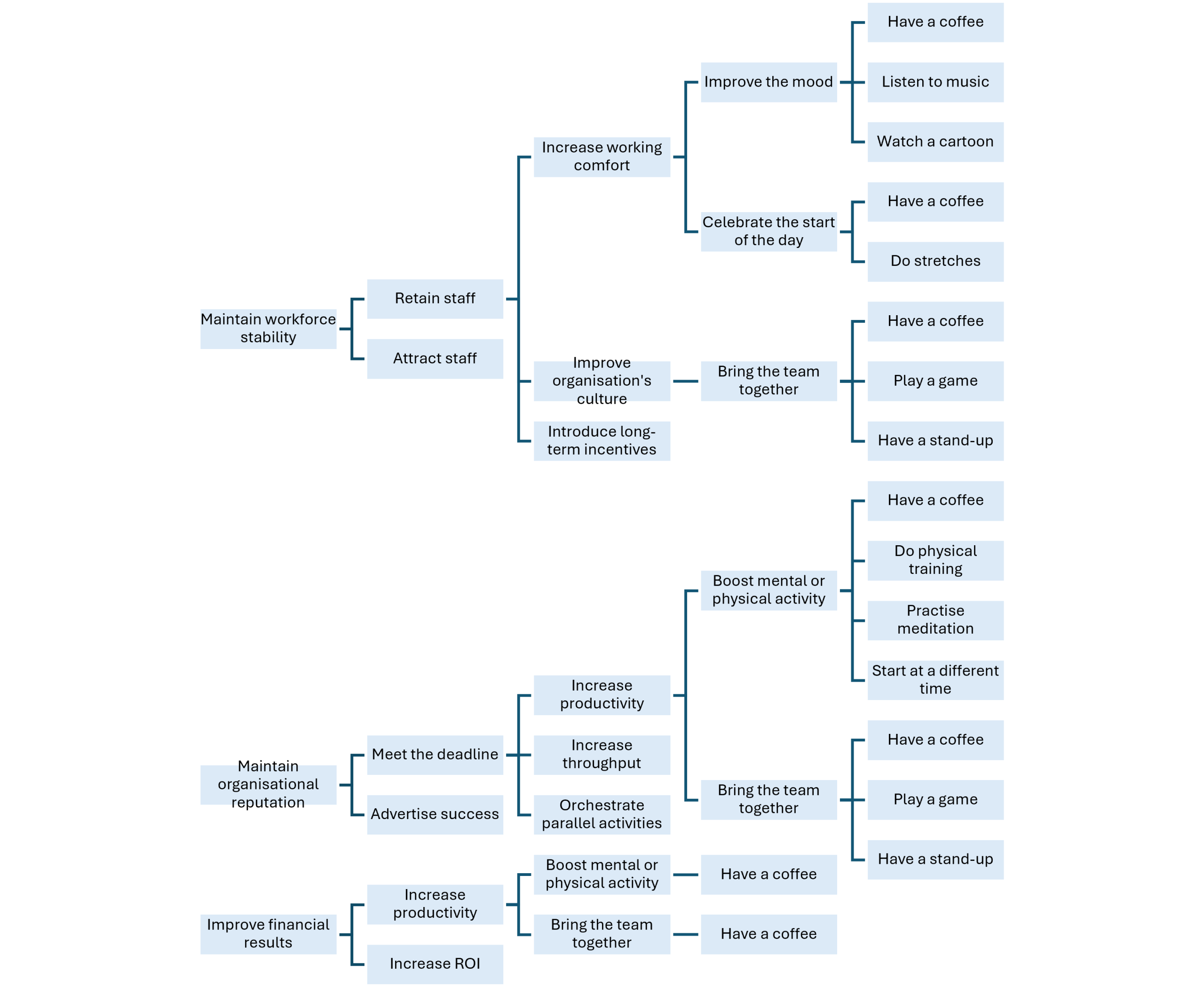
By establishing local relationships and applying the same technique to newly discovered nodes, the Jack Tree develops into:
- Maintain workforce stability
- Retain staff
- Increase working comfort
- Improve the mood
- Have a coffee
- Listen to music
- Watch a cartoon
- Celebrate the start of the day
- Have a coffee
- Do stretches
- Improve the mood
- Improve organisation’s culture
- Bring the team together
- Have a coffee
- Play a game
- Have a stand-up
- Bring the team together
- Introduce long-term incentives
- Increase working comfort
- Attract staff
- Retain staff
- Maintain organisational reputation
- Meet the deadline
- Increase productivity
- Boost mental or physical activity
- Have a coffee
- Do physical training
- Practise meditation
- Start at a different time
- Bring the team together
- Have a coffee
- Play a game
- Have a stand-up
- Boost mental or physical activity
- Increase throughput
- Orchestrate parallel activities
- Increase productivity
- Advertise success
- Meet the deadline
- Improve financial results
- Increase productivity
- Boost mental or physical activity
- Have a coffee
- Bring the team together
- Have a coffee
- Boost mental or physical activity
- Increase ROI
- Increase productivity
Output
A comprehensive hierarchical structure of discrete requirements where each child resolves its parent by adding the required clarification or context.
The Jack Tree is inherently hierarchical – making relationships, alternatives, and trace paths visually explicit. While a diagram is not required, the same structure can be visualised for easier navigation:
Sidenotes
The two elaboration formats operate in opposite directions. I want to… So that I can… helps trace a Jack towards a broader reason or outcome, while IN order to… WE need to… helps identify what may resolve a Jack below it. Used together, they help establish and cross-check local relationships within the tree.
For this use case, Have a coffee is treated as a self-contained action and is not decomposed further. This is an analytical choice rather than a structural limitation; it could be decomposed if additional detail were relevant.
Although this Jack Tree was constructed around Have a coffee, that Jack represents only one part of the original stakeholder statement. A complete Jack Tree would also address the other semantic details identified earlier, including User, Portioned, Accessible, and Before major activities start. These remain part of the broader analytical structure even though this use case follows the coffee-related branch in detail.
Starting from the granular Have a coffee Jack, TRACE expands the analysis through progressively broader levels of context, reaching plausible organisational and strategic objectives. The initially proposed solution exposes a range of alternatives that remain directly traceable to:
- Maintain workforce stability
- Maintain organisational reputation
- Improve financial results
The tree also exposes alternatives. Have a coffee is only one way to Improve the mood, just as Improve the mood is only one way to Increase working comfort. Alternatives are preserved rather than discarded, allowing different options to remain visible as the analysis develops.
Some Jacks appear more than once. For example, Have a coffee, Bring the team together, and Increase productivity occur in different branches. These are not necessarily duplicates: the meaning of a Jack is contextual and depends on its position and inherited context in the tree.
The result is more than a hierarchy of increasingly broad or detailed requirements. The Jack Tree preserves the trace between them, making it possible to see not only what is being considered, but also the context in which each requirement exists and what it resolves.
Jack Semaphore – PRIORITISE
Input
Jack Tree.
Action
PRIORITISE the Jack Tree by applying visual indicators to selected Jacks, making delivery and decision-making considerations visible without changing the underlying analytical structure.
Semaphore may represent:
- in/out of scope;
- priority;
- weight;
- implementation cost;
- timeframes;
- development status;
- dependencies;
- teams or functional areas.
Indicators can be background colours, borders, gradients, icons, numbers, or other visual distinctions.
For this use case, a branch of the Coffee Jack Tree is used to demonstrate several possible Semaphore indications:
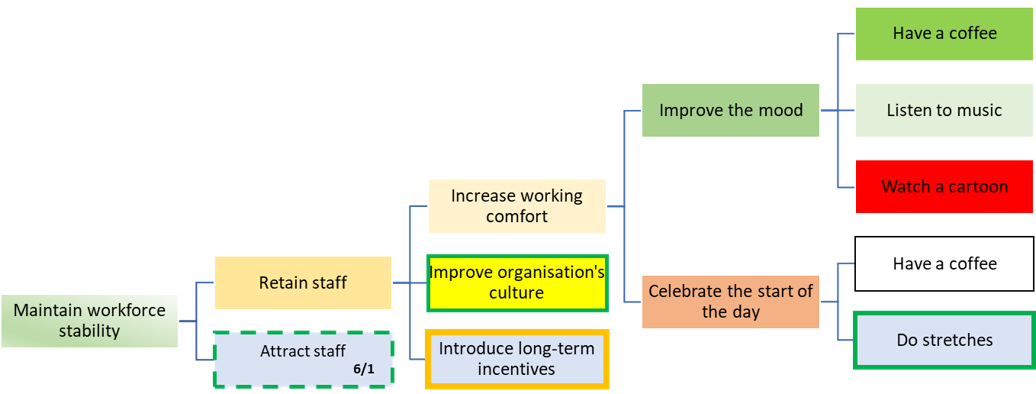
The example demonstrates different ways of marking Jacks rather than prescribing a particular visual scheme.
Output
A semaphored Jack Tree where selected delivery and decision-making considerations are visible alongside the existing analytical structure.
Sidenotes
Jack Semaphore adds information to the Jack Tree without changing its Jacks or relationships. The analytical meaning established through TRACE remains intact while additional perspectives become visible.
Semaphore is not limited to priority. Different views may represent scope, cost, readiness, responsibility, dependency, or other relevant considerations.
Options can remain visible even when currently unfavourable or out of scope. They can be marked rather than deleted.
Because Jack meaning depends on position, identical Jacks can receive different Semaphore treatment in different contexts. Have a coffee, for example, may be treated differently under Improve the mood, Celebrate the start of the day, and Bring the team together.
Where several indicator types are used, they should be defined consistently so that the resulting view remains interpretable.
Jack Story – EXPRESS
Input
Selected Jack Tree lineage.
For this use case:
- Maintain organisational reputation
- Meet the deadline
- Increase productivity
- Bring the team together
- Have a coffee
- Bring the team together
- Increase productivity
- Meet the deadline
Action
EXPRESS the selected lineage as a single requirement while preserving its Jack Tree lineage.
Start with the selected Jack and recursively stack its parent Jacks to the required level of context.
The selected lineage:
Have a coffee → Bring the team together → Increase productivity → Meet the deadline → Maintain organisational reputation
becomes:
This is Coffee we need to Have
To Bring the team together
To Increase productivity
To Meet the deadline
To Maintain organisational reputation.
Output
A Jack Story that expresses the selected requirement together with its inherited context and lineage.
Sidenotes
The Jack Story uses a recursive structure similar to The House That Jack Built. Each additional Jack extends the context of the previous one while preserving the original Jack Tree lineage.
Unlike a conventional requirement or User Story, a Jack Story is deliberately strict about retaining that lineage. Its purpose is not to produce the most natural sentence, but to EXPRESS the analytical path represented by the tree.
This becomes particularly useful where identical Jacks occur in different contexts. Bring the team together, for example, appears elsewhere in the Coffee Jack Tree. In this Jack Story, its position makes it explicit that the action is being considered to Increase productivity, which in turn supports Meet the deadline and Maintain organisational reputation.
The depth of a Jack Story can be adjusted to the context required by its audience or purpose. A shorter Story may stop after a few levels, while a longer one can preserve the lineage through to an organisational objective.
Jack Story is therefore a high-fidelity textual representation of Jack Tree lineage. Its recursive structure is intentional: each step adds, clarifies, or specifies the context of the Jack while preserving its analytical position in the hierarchy.
Jack Scenario – COMPOSE
Input
Selected concepts from different parts of the broader Jack Tree.
For this use case, these include:
- Single person
- Team
- Improve the mood
- Increase productivity
- Bring the team together
- Have a coffee
- Play a game
Action
COMPOSE selected Jack Tree concepts into practical scenarios by returning conditional and compositional logic.
Jack Scenario can combine concepts from different levels and branches of the Jack Tree, bringing together actions, Users, conditions, timing, and other circumstances relevant to a particular delivery or testing situation.
For example:
IF a Single person needs to Improve the mood, THEN Have a coffee.
WHEN the Team needs to Increase productivity by Bringing the team together, Have a coffee AND Play a game.
Output
Contextual scenarios composed from selected Jack Tree content for practical delivery or testing purposes.
Sidenotes
Jack Scenario does not need to follow a single Jack Tree lineage. It can combine relevant concepts from different parts of the tree to represent a particular situation.
This is where conditional and compositional logic returns to the analysis. Relationships such as IF, THEN, WHEN, AND, OR, BEFORE, and AFTER can connect independently structured concepts into meaningful scenarios.
The wording of individual Jacks does not need to remain literal during composition. Grammar and connecting language can be adjusted where needed, while the underlying analytical concepts remain anchored in the Jack Tree.
The same Jack Tree can therefore support many different Jack Scenarios. Different Users, conditions, actions, alternatives, and combinations can be selected depending on the delivery or testing context.
Jack Intent – PERCEIVE
Input
Semaphored or prioritised Jack Tree.
Action
PERCEIVE the broader intent represented by a selected cross-section of the Jack Tree.
Select a target Jack, group of Jacks, or node, then consider several relevant levels of its surrounding structure. The selected levels do not need to be consecutive.
Instead of preserving the exact wording of individual Jacks, identify the common meaning represented at each selected level and transform those meanings into a concise statement appropriate to the intended audience.
For example, starting from Have a coffee and moving towards Increase working comfort:
- Working comfort → Job satisfaction
- Mood / celebration → Team inspiration
- Coffee → Coffee
This can be expressed as:
Provide job satisfaction by inspiring teams with coffee.
An alternative interpretation of the same cross-section may produce:
- Increase → Promote
- Mood / celebration → Team emotions
- Coffee → Selected drink
Resulting in:
Promote emotional comfort through providing coffee to project teams.
At a broader organisational level:
- Stability / reputation / financial results → Prosperity
- Retention / attraction / productivity → Staff
- Comfort / culture / incentives → Satisfaction
This produces the strategic Jack Intent:
Ensure company prosperity through satisfaction of staff.
Output
A concise Intent representing the broader meaning of the selected Jack Tree cross-section for a particular audience or purpose.
Sidenotes
Jack Intent deliberately moves away from the precision of individual Jacks, commonalising their meaning to express a broader intent.
Different interpretations may be produced from the same cross-section depending on the intended audience and purpose.
The selected levels do not need to be consecutive.
Conclusion
Starting with “I want a cup of coffee in the morning on my desk,” SJM progressively:
RAISEd the statement into solution-agnostic meaning → SCRUTINISEd it into alternatives and initial Jacks → TRACEd those Jacks into a wider problem space → PRIORITISEd delivery considerations → EXPRESSed precise inherited context → COMPOSEd practical scenarios → PERCEIVEd broader intent.
From a subjective stakeholder statement, SJM constructed a broad framework of traceable requirements representing business needs, objectives, and solution options at different levels, readily usable for specific delivery settings and informed decision-making.